Imagine you are at a bar. The bouncer stops you at the door and asks for your ID to verify your age. You hand over your driver’s license. The bouncer looks at it and nods, letting you in. But in that brief exchange, you shared much more than just your age. You revealed your full name, your home address, your exact date of birth, and even your organ donor status.
The bouncer only needed to know one thing: “Are you over 21?” Instead, you handed over a trove of personal data that could be stored, copied, or remembered.
This is the fundamental privacy flaw in how we currently verify information online and offline. We prove who we are by showing everything we have. But what if you could prove you are old enough to enter the bar without revealing your birth date? What if you could prove you have enough money for a transaction without showing your bank balance?
This is the promise of Zero-Knowledge Proofs (ZKPs). It is a cryptographic method that allows one party to prove to another that a statement is true, without revealing any specific information about the statement itself. It is a concept that sounds paradoxical—proving knowledge without sharing it—but it is rapidly becoming one of the most important technologies for the future of the internet, blockchain, and digital identity.
Understanding the Basics
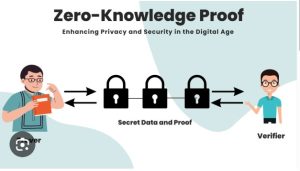
At its core, a Zero Knowledge Proof involves two parties:
- The Prover: The entity that wants to prove they know a secret or that a statement is true.
- The Verifier: The entity that needs to be convinced that the statement is true, without learning the secret.
The goal is simple. The Prover wants to convince the Verifier that they possess specific information (like a password, a private key, or a solution to a math problem) without actually handing over that information.
In the physical world, this happens rarely. If you want to prove you know a password, you usually have to type it in. If you want to prove you own a key, you unlock the door. In the digital world, ZKPs allow you to unlock the door mathematically without ever showing the key.
The Three Essential Criteria
For a cryptographic protocol to qualify as a Zero-Knowledge Proof, it must satisfy three specific properties. These criteria ensure the system is secure, reliable, and truly private.
- Completeness: If the statement is true and both the Prover and Verifier follow the rules, the Verifier will be convinced. A honest Prover will always succeed in proving the truth to an honest Verifier.
- Soundness: If the statement is false, a dishonest Prover cannot convince the Verifier that it is true, except with a negligible probability. You cannot fake the proof without actually knowing the secret.
- Zero-Knowledge: This is the defining characteristic. If the statement is true, the Verifier learns nothing other than the fact that the statement is true. They do not learn the secret, nor do they gain any ability to prove the statement to someone else later.
Explaining the Magic: The Color-Blind Friend Analogy
Cryptography involves heavy mathematics, which can be intimidating. To understand how this works without complex equations, we can look at a classic analogy involving two friends and two balls.
Imagine you have a friend who is color-blind and cannot distinguish between a red ball and a green ball. To him, they look identical. You, however, can see the colors clearly. You want to prove to him that the balls are different colors, but—here is the twist—you don’t want to tell him which one is red and which one is green. You just want to prove they are different.
Here is the “protocol” you follow:
- You give the two balls to your friend.
- He puts them behind his back. He decides secretly whether to switch them or keep them in the same hand.
- He brings them out and asks you: “Did I switch the balls?”
- Because you can see the colors, you can easily tell if the red ball moved to the other hand. You answer correctly.
If you tried this once, you have a 50% chance of guessing correctly even if you couldn’t see the colors. Your friend isn’t convinced yet. But if you repeat this process 10 times, the chance of you guessing correctly every single time without actually seeing the colors becomes 1 in 1,024. If you do it 20 times, the probability of faking it is roughly one in a million.
After enough rounds, your friend is mathematically convinced that you can tell the difference (Completeness and Soundness). However, he still doesn’t know which ball is red and which is green (Zero-Knowledge). You proved you have the knowledge without sharing the specific details.
Types of Zero-Knowledge Proofs
Not all ZKPs are built the same way. Over the years, cryptographers have developed different approaches to optimize for speed, security, and computing power.
Interactive Zero-Knowledge Proofs
The example with the color-blind friend is an interactive proof. It requires a back-and-forth dialogue between the Prover and the Verifier. The Verifier challenges the Prover multiple times until they are satisfied. While this works well in theory, it is not practical for blockchain or web applications where automated systems need to verify millions of transactions instantly without a direct “conversation.”
Non-Interactive Zero-Knowledge Proofs
To solve the efficiency problem, cryptographers developed non-interactive proofs. In this model, the Prover generates a single, compact proof that can be sent to the Verifier. The Verifier can check this proof instantly without any back-and-forth communication.
This is where you might encounter acronyms like zk-SNARKs (Zero-Knowledge Succinct Non-Interactive Argument of Knowledge) and zk-STARKs (Zero-Knowledge Scalable Transparent Argument of Knowledge). These technologies are currently the backbone of privacy-focused blockchain networks.
Real-World Applications
While the math is abstract, the applications are concrete and revolutionary. Here is how ZKP technology is reshaping industries.
Blockchain and Scalability
Public blockchains like Bitcoin and Ethereum are transparent by design. Everyone can see every transaction. While this creates trust, it destroys privacy. ZKPs allow for privacy coins (like Zcash) where transaction amounts and sender/receiver addresses remain hidden, yet the network still verifies that the money exists and hasn’t been spent twice.
Furthermore, Ethereum is using ZKPs for scalability. “ZK-rollups” bundle hundreds of transactions into a single proof off-chain and then submit just that validity proof to the main Ethereum network. This reduces congestion and fees while maintaining security.
Digital Identity and Authentication
Going back to the bar example, ZKPs can revolutionize identity management. Instead of sharing your passport scan with a crypto exchange, a bank, or a website, you could generate a proof that your passport is valid and belongs to you.
Services could verify “User is a citizen of Country X” or “User has a credit score above 700” without ever storing (or leaking) the underlying documents. This minimizes the risk of data breaches because companies won’t hold the sensitive data in the first place.
Secure Voting Systems
Electronic voting struggles with two competing needs: privacy (my vote must be secret) and auditability (we must prove the count is accurate). ZKPs can bridge this gap. A voter can prove they are eligible to vote and that their vote was included in the final tally, without revealing who they voted for.
Current Limitations and Risks
Despite the potential, ZKPs are not a magic bullet—yet. There are significant hurdles to widespread adoption.
Computational Intensity: Generating a zero-knowledge proof requires significant computational power. It is heavy math. While verification is usually fast, the creation of the proof can be slow and energy-intensive, which is a bottleneck for mobile devices.
Trusted Setups: Some ZKP protocols (like early versions of zk-SNARKs) require a “trusted setup” phase where cryptographic keys are created. If the people who create these keys conspire or if the keys are leaked, they could forge fake proofs. Newer protocols (like zk-STARKs) are moving away from trusted setups to eliminate this risk.
Complexity: This is highly specialized cryptography. Implementing ZKPs incorrectly can lead to severe security vulnerabilities. There are very few developers who deeply understand how to build these systems safely, limiting the speed of innovation.
Frequently Asked Questions
Are Zero-Knowledge Proofs 100% secure?
In cryptography, we deal in probabilities. ZKPs provide cryptographic certainty that approaches 100%. The probability of a prover cheating successfully in a sound system is so astronomically low that it is considered impossible for practical purposes. However, like all code, the implementation can have bugs.
Is ZKP only for cryptocurrency?
No. While crypto is currently driving the innovation, the technology applies to any digital system requiring privacy. This includes password security, nuclear disarmament verification (proving a warhead is dismantled without revealing design secrets), and medical data sharing.
Does quantum computing threaten ZKPs?
Some ZKP methods rely on mathematical problems that quantum computers could theoretically solve easily. However, post-quantum cryptography is an active field of research, and protocols like zk-STARKs are generally considered “quantum-resistant.”
The Path Toward True Privacy
We are moving toward a digital existence where our data is our most valuable asset. The current model—where we pay for services by handing over that asset—is broken. Zero-Knowledge Proofs offer a way out. They allow us to interact, transact, and verify truth without surrendering our privacy.
The transition won’t happen overnight. It requires faster algorithms, better hardware, and easier tools for developers. But the destination is worth the effort. By decoupling “verification” from “observation,” ZKPs can help build an internet where privacy is not just an option settings toggle, but the default foundation of the web.
 :
https://insidetechie.blog/
:
https://insidetechie.blog/